


 癌症的基本特征包括细胞增殖、血管生成、迁移、凋亡逃避机制和细胞永生等。找到癌症发生过程中这些通路的关键标记物和对应的抗体用于检测至关重要。
 为您推荐一个泛素化位点预测神器——泛素化分析工具,可以为您的蛋白的泛素化位点作出预测和评分。
 细胞自噬受体图形绘图工具为你的蛋白的细胞受体结合位点作出预测和评分,识别结合到自噬通路中的蛋白是非常重要的,便于让我们理解自噬在正常生理、病理过程中的作用,如发育、细胞分化、神经退化性疾病、压力条件下、感染和癌症。
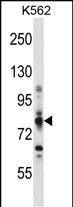
CPT1A Antibody (C-term)
Affinity Purified Rabbit Polyclonal Antibody (Pab)
- 产品详情
- 文献引用 : 1
- 实验流程
- 背景知识
Application 
| WB, E |
|---|---|
| Primary Accession | P50416 |
| Other Accession | NP_001027017.1, NP_001867.2 |
| Reactivity | Human |
| Host | Rabbit |
| Clonality | Polyclonal |
| Isotype | Rabbit IgG |
| Calculated MW | 88368 Da |
| Antigen Region | 728-756 aa |
| Gene ID | 1374 |
|---|---|
| Other Names | Carnitine O-palmitoyltransferase 1, liver isoform, CPT1-L, Carnitine O-palmitoyltransferase I, liver isoform, CPT I, CPTI-L, Carnitine palmitoyltransferase 1A, CPT1A, CPT1 |
| Target/Specificity | This CPT1A antibody is generated from rabbits immunized with a KLH conjugated synthetic peptide between 728-756 amino acids from the C-terminal region of human CPT1A. |
| Dilution | WB~~1:1000 E~~Use at an assay dependent concentration. |
| Format | Purified polyclonal antibody supplied in PBS with 0.09% (W/V) sodium azide. This antibody is purified through a protein A column, followed by peptide affinity purification. |
| Storage | Maintain refrigerated at 2-8°C for up to 2 weeks. For long term storage store at -20°C in small aliquots to prevent freeze-thaw cycles. |
| Precautions | CPT1A Antibody (C-term) is for research use only and not for use in diagnostic or therapeutic procedures. |
| Name | CPT1A (HGNC:2328) |
|---|---|
| Synonyms | CPT1 |
| Function | Catalyzes the transfer of the acyl group of long-chain fatty acid-CoA conjugates onto carnitine, an essential step for the mitochondrial uptake of long-chain fatty acids and their subsequent beta-oxidation in the mitochondrion (PubMed:11350182, PubMed:14517221, PubMed:16651524, PubMed:9691089). Also possesses a lysine succinyltransferase activity that can regulate enzymatic activity of substrate proteins such as ENO1 and metabolism independent of its classical carnitine O-palmitoyltransferase activity (PubMed:29425493). Plays an important role in hepatic triglyceride metabolism (By similarity). Also plays a role in inducible regulatory T-cell (iTreg) differentiation once activated by butyryl-CoA that antagonizes malonyl- CoA-mediated CPT1A repression (By similarity). Sustains the IFN-I response by recruiting ZDHCC4 to palmitoylate MAVS at the mitochondria leading to MAVS stabilization and activation (PubMed:38016475). Promotes ROS-induced oxidative stress in liver injury via modulation of NFE2L2 and NLRP3-mediated signaling pathways (By similarity). |
| Cellular Location | Mitochondrion outer membrane; Multi-pass membrane protein |
| Tissue Location | Strong expression in kidney and heart, and lower in liver and skeletal muscle |
For Research Use Only. Not For Use In Diagnostic Procedures.

Provided below are standard protocols that you may find useful for product applications.
BACKGROUND
The mitochondrial oxidation of long-chain fatty acids is initiated by the sequential action of carnitine palmitoyltransferase I (which is located in the outer membrane and is detergent-labile) and carnitine palmitoyltransferase II (which is located in the inner membrane and is detergent-stable), together with a carnitine-acylcarnitine translocase. CPT I is the key enzyme in the carnitine-dependent transport across the mitochondrial inner membrane and its deficiency results in a decreased rate of fatty acid beta-oxidation. Alternatively spliced transcript variants encoding different isoforms have been found for this gene.
REFERENCES
Gessner, B.D., et al. Pediatrics 126(5):945-951(2010)
Collins, S.A., et al. Mol. Genet. Metab. 101 (2-3), 200-204 (2010) :
Bailey, S.D., et al. Diabetes Care 33(10):2250-2253(2010)
Song, S., et al. Mol. Cell. Endocrinol. 325 (1-2), 54-63 (2010) :
Ruano, G., et al. Pharmacogenomics 11(7):959-971(2010)

终于等到您。ABCEPTA(百远生物)抗体产品。
点击下方“我要评价 ”按钮提交您的反馈信息,您的反馈和评价是我们最宝贵的财富之一,
我们将在1-3个工作日内处理您的反馈信息。
如有疑问,联系:0512-88856768 tech-china@abcepta.com.


