


 癌症的基本特征包括细胞增殖、血管生成、迁移、凋亡逃避机制和细胞永生等。找到癌症发生过程中这些通路的关键标记物和对应的抗体用于检测至关重要。
 为您推荐一个泛素化位点预测神器——泛素化分析工具,可以为您的蛋白的泛素化位点作出预测和评分。
 细胞自噬受体图形绘图工具为你的蛋白的细胞受体结合位点作出预测和评分,识别结合到自噬通路中的蛋白是非常重要的,便于让我们理解自噬在正常生理、病理过程中的作用,如发育、细胞分化、神经退化性疾病、压力条件下、感染和癌症。
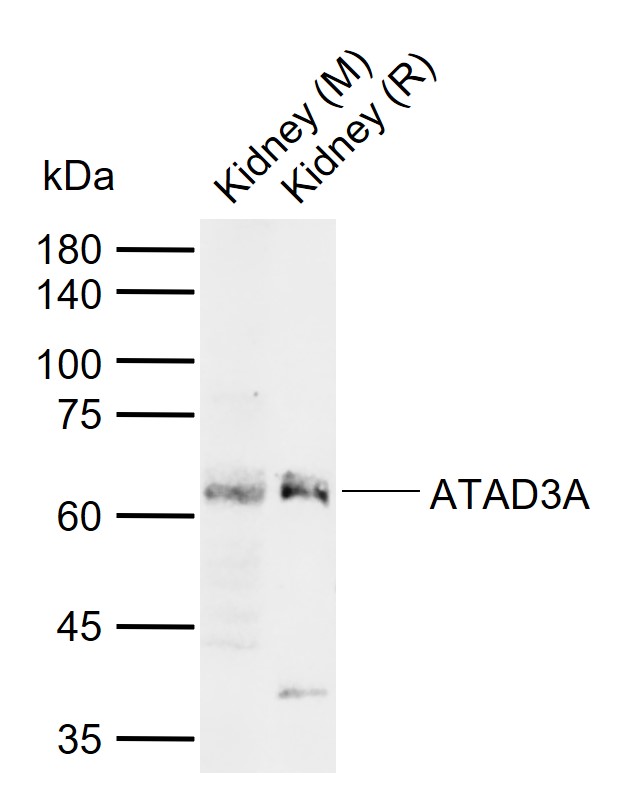
ATAD3A Rabbit pAb
ATAD3A Rabbit pAb
- 产品详情
- 实验流程
- 背景知识
Application 
| WB |
|---|---|
| Primary Accession | Q9NVI7 |
| Reactivity | Mouse, Rat |
| Predicted | Human, Pig, Sheep |
| Host | Rabbit |
| Clonality | Polyclonal |
| Calculated MW | 66218 Da |
| Physical State | Liquid |
| Immunogen | KLH conjugated synthetic peptide derived from human ATAD3A |
| Epitope Specificity | 351-450/634 |
| Isotype | IgG |
| Purity | affinity purified by Protein A |
| Buffer | 0.01M TBS (pH7.4) with 1% BSA, 0.02% Proclin300 and 50% Glycerol. |
| SUBCELLULAR LOCATION | Mitochondrion inner membrane; Single-pass membrane protein. Mitochondrion matrix, mitochondrion nucleoid. Note=In the mitochondrial inner membrane, enriched in sites with the potential to form contacts with the outer membrane. The N-terminal domain interacts with the inner surface of the mitochondrial outer membrane and the C-terminal domain localizes in a specific matrix compartment, where it is associated with nucleoids. |
| SIMILARITY | Belongs to the AAA ATPase family. |
| SUBUNIT | Can form homooligomers. Homodimer formation at the N-terminus may be regulated by ATP and is required for the interaction with the inner surface of the mitochondrial outer membrane and correct mitochondrial homeostasis. Interacts with components of the mitochondrial ribosome and with other proteins involved in mitochondrial RNA metabolism. May also interact with protein involved in lipid metabolism, including STARD9. May interact with FAM210A. Interacts with GADD45GIP1. Interacts with S100B in a Ca(+2)- and Zn(+2)-dependent manner; this interaction probably occurs in the cytosol prior to mitochondrial targeting. S100B could assist ATAD3A cytoplasmic processing, preventing aggregation and favoring mitochondrial localization. Interacts with HSP60/HSPD1. Forms heterooligomers with ATAD3B; this interaction may affect ATAD3A activity. |
| Important Note | This product as supplied is intended for research use only, not for use in human, therapeutic or diagnostic applications. |
| Background Descriptions | The AAA ATPase family of molecular chaperones are characterized by a highly conserved AAA motif. Composed of 200-250 residues, the AAA domain contains Walker homology sequences and imparts ATPase activity. Members of the AAA ATPase family act as DNA helicases as well as transcription factors and are thought to be involved in several cellular functions such as cell-cycle regulation, protein proteolysis, organelle biogenesis and vesicle-mediated protein transport. Mitochondrial membrane proteins ATAD3A and ATAD3B contribute to the stabilization of nucleoids which are large mitochondrial DNA (mtDNA)-protein complexes. ATAD3A/B may participate in the transformation pathway and the chemosensitivity of oligodendrogliomas. The genes encoding ATAD3A/B/C maps to human chromosome 1, which houses over 3,000 genes and is the largest human chromosome spanning about 260 million base pairs and making up 8% of the human genome. |
| Gene ID | 55210 |
|---|---|
| Other Names | ATPase family AAA domain-containing protein 3A, 3.6.1.-, ATAD3A {ECO:0000303|PubMed:37832546, ECO:0000312|HGNC:HGNC:25567} |
| Target/Specificity | Overexpressed in lung adenocarcinomas (at protein level). |
| Dilution | WB=1:500-2000 |
| Storage | Store at -20 °C for one year. Avoid repeated freeze/thaw cycles. When reconstituted in sterile pH 7.4 0.01M PBS or diluent of antibody the antibody is stable for at least two weeks at 2-4 °C. |
| Name | ATAD3A {ECO:0000303|PubMed:37832546, ECO:0000312|HGNC:HGNC:25567} |
|---|---|
| Function | Essential for mitochondrial network organization, mitochondrial metabolism and cell growth at organism and cellular level (PubMed:17210950, PubMed:20154147, PubMed:22453275, PubMed:31522117, PubMed:37832546, PubMed:39116259). May play an important role in mitochondrial protein synthesis (PubMed:22453275). May also participate in mitochondrial DNA replication (PubMed:17210950). May bind to mitochondrial DNA D-loops and contribute to nucleoid stability (PubMed:17210950). Required for enhanced channeling of cholesterol for hormone-dependent steroidogenesis (PubMed:22453275). Involved in mitochondrial-mediated antiviral innate immunity (PubMed:31522117). Required to protect mitochondria from the PERK-mediated unfolded protein response: specifically inhibits the activity of EIF2AK3/PERK at mitochondria-endoplasmic reticulum contact sites, thereby providing a safe haven for mitochondrial protein translation during endoplasmic reticulum stress (PubMed:39116259). Ability to inhibit EIF2AK3/PERK is independent of its ATPase activity (PubMed:39116259). Also involved in the mitochondrial DNA damage response by promoting signaling between damaged genomes and the mitochondrial membrane, leading to activation of the integrated stress response (ISR) (PubMed:37832546). |
| Cellular Location | Mitochondrion inner membrane; Single-pass membrane protein. Mitochondrion matrix, mitochondrion nucleoid Note=In the mitochondrial inner membrane, enriched in sites with the potential to form contacts with the outer membrane (PubMed:20154147, PubMed:20349121). The N-terminal domain interacts with the inner surface of the mitochondrial outer membrane and the C-terminal domain localizes in a specific matrix compartment, where it is associated with nucleoids (PubMed:18063578). Also present at mitochondria-endoplasmic reticulum contact sites; where it interacts with EIF2AK3/PERK (PubMed:39116259). |
| Tissue Location | Overexpressed in lung adenocarcinomas (at protein level). |
For Research Use Only. Not For Use In Diagnostic Procedures.
Provided below are standard protocols that you may find useful for product applications.
BACKGROUND
The AAA ATPase family of molecular chaperones are characterized by a highly conserved AAA motif. Composed of 200-250 residues, the AAA domain contains Walker homology sequences and imparts ATPase activity. Members of the AAA ATPase family act as DNA helicases as well as transcription factors and are thought to be involved in several cellular functions such as cell-cycle regulation, protein proteolysis, organelle biogenesis and vesicle-mediated protein transport. Mitochondrial membrane proteins ATAD3A and ATAD3B contribute to the stabilization of nucleoids which are large mitochondrial DNA (mtDNA)-protein complexes. ATAD3A/B may participate in the transformation pathway and the chemosensitivity of oligodendrogliomas. The genes encoding ATAD3A/B/C maps to human chromosome 1, which houses over 3,000 genes and is the largest human chromosome spanning about 260 million base pairs and making up 8% of the human genome.

终于等到您。ABCEPTA(百远生物)抗体产品。
点击下方“我要评价 ”按钮提交您的反馈信息,您的反馈和评价是我们最宝贵的财富之一,
我们将在1-3个工作日内处理您的反馈信息。
如有疑问,联系:0512-88856768 tech-china@abcepta.com.


