


 癌症的基本特征包括细胞增殖、血管生成、迁移、凋亡逃避机制和细胞永生等。找到癌症发生过程中这些通路的关键标记物和对应的抗体用于检测至关重要。
 为您推荐一个泛素化位点预测神器——泛素化分析工具,可以为您的蛋白的泛素化位点作出预测和评分。
 细胞自噬受体图形绘图工具为你的蛋白的细胞受体结合位点作出预测和评分,识别结合到自噬通路中的蛋白是非常重要的,便于让我们理解自噬在正常生理、病理过程中的作用,如发育、细胞分化、神经退化性疾病、压力条件下、感染和癌症。
EHD1 Antibody (C-term)
Affinity Purified Rabbit Polyclonal Antibody (Pab)
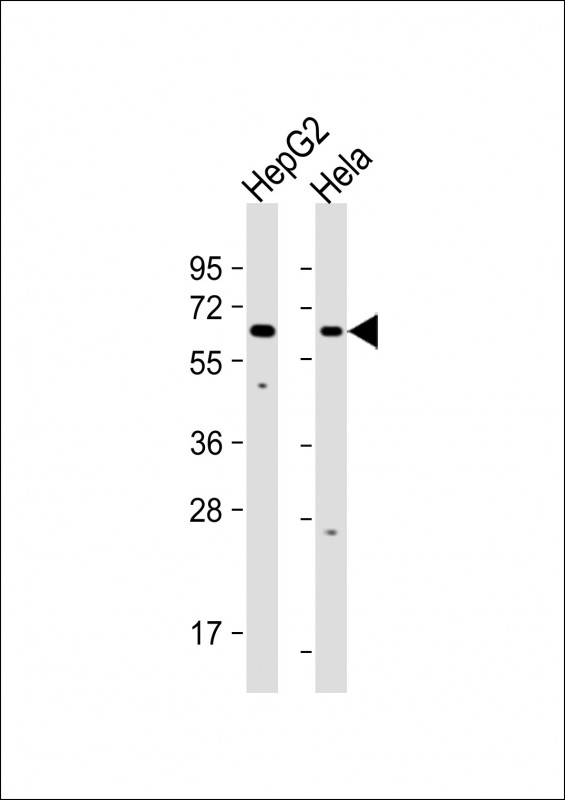
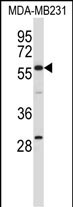
- 产品详情
- 实验流程
- 背景知识
Application 
| WB, E |
|---|---|
| Primary Accession | Q9H4M9 |
| Other Accession | Q641Z6, Q9WVK4, Q5E9R3, NP_006786.2 |
| Reactivity | Human |
| Predicted | Bovine, Mouse, Rat |
| Host | Rabbit |
| Clonality | Polyclonal |
| Isotype | Rabbit IgG |
| Calculated MW | 60627 Da |
| Antigen Region | 410-438 aa |
| Gene ID | 10938 |
|---|---|
| Other Names | EH domain-containing protein 1, PAST homolog 1, hPAST1, Testilin, EHD1, PAST, PAST1 |
| Target/Specificity | This EHD1 antibody is generated from rabbits immunized with a KLH conjugated synthetic peptide between 410-438 amino acids from the C-terminal region of human EHD1. |
| Dilution | WB~~1:1000 E~~Use at an assay dependent concentration. |
| Format | Purified polyclonal antibody supplied in PBS with 0.09% (W/V) sodium azide. This antibody is purified through a protein A column, followed by peptide affinity purification. |
| Storage | Maintain refrigerated at 2-8°C for up to 2 weeks. For long term storage store at -20°C in small aliquots to prevent freeze-thaw cycles. |
| Precautions | EHD1 Antibody (C-term) is for research use only and not for use in diagnostic or therapeutic procedures. |
| Name | EHD1 (HGNC:3242) |
|---|---|
| Function | ATP- and membrane-binding protein that controls membrane reorganization/tubulation upon ATP hydrolysis. In vitro causes vesiculation of endocytic membranes (PubMed:24019528). Acts in early endocytic membrane fusion and membrane trafficking of recycling endosomes (PubMed:15020713, PubMed:17233914, PubMed:20801876). Recruited to endosomal membranes upon nerve growth factor stimulation, indirectly regulates neurite outgrowth (By similarity). Plays a role in myoblast fusion (By similarity). Involved in the unidirectional retrograde dendritic transport of endocytosed BACE1 and in efficient sorting of BACE1 to axons implicating a function in neuronal APP processing (By similarity). Plays a role in the formation of the ciliary vesicle (CV), an early step in cilium biogenesis (PubMed:31615969). Proposed to be required for the fusion of distal appendage vesicles (DAVs) to form the CV by recruiting SNARE complex component SNAP29. Is required for recruitment of transition zone proteins CEP290, RPGRIP1L, TMEM67 and B9D2, and of IFT20 following DAV reorganization before Rab8-dependent ciliary membrane extension. Required for the loss of CCP110 form the mother centriole essential for the maturation of the basal body during ciliogenesis (PubMed:25686250). |
| Cellular Location | Recycling endosome membrane; Peripheral membrane protein; Cytoplasmic side. Early endosome membrane; Peripheral membrane protein; Cytoplasmic side. Cell membrane {ECO:0000250|UniProtKB:Q9WVK4}; Peripheral membrane protein; Cytoplasmic side. Cell projection, cilium membrane; Peripheral membrane protein; Cytoplasmic side. Note=Preferentially associates with tubular recycling endosomes (PubMed:15020713, PubMed:17233914, PubMed:19864458, PubMed:23596323). Colocalizes with FER1L5 at plasma membrane in myoblasts and myotubes (By similarity). Localizes to the ciliary pocket from where the cilium protrudes (PubMed:25686250). Colocalizes with BACE1 in tubulovesicular cytoplasmic membranes. Colocalizes with BACE1 and APP amyloid beta proteins in hippocampal mossy fiber terminals (By similarity). {ECO:0000250|UniProtKB:Q9WVK4, ECO:0000269|PubMed:15020713, ECO:0000269|PubMed:17233914, ECO:0000269|PubMed:19864458, ECO:0000269|PubMed:23596323, ECO:0000269|PubMed:25686250} |
| Tissue Location | Highly expressed in testis. |
For Research Use Only. Not For Use In Diagnostic Procedures.
Provided below are standard protocols that you may find useful for product applications.
BACKGROUND
This gene belongs to a highly conserved gene family encoding EPS15 homology (EH) domain-containing proteins. The protein-binding EH domain was first noted in EPS15, a substrate for the epidermal growth factor receptor. The EH domain has been shown to be an important motif in proteins involved in protein-protein interactions and in intracellular sorting. The protein encoded by this gene is thought to play a role in the endocytosis of IGF1 receptors.
REFERENCES
Gudmundsson, H., et al. Circ. Res. 107(1):84-95(2010)
Sharma, M., et al. Mol. Biol. Cell 20(24):5181-5194(2009)
Kieken, F., et al. Protein Sci. 18(12):2471-2479(2009)
Jovic, M., et al. Mol. Biol. Cell 20(11):2731-2743(2009)
Fichtman, B., et al. Cell. Mol. Biol. Lett. 13(4):632-648(2008)

终于等到您。ABCEPTA(百远生物)抗体产品。
点击下方“我要评价 ”按钮提交您的反馈信息,您的反馈和评价是我们最宝贵的财富之一,
我们将在1-3个工作日内处理您的反馈信息。
如有疑问,联系:0512-88856768 tech-china@abcepta.com.


