


 癌症的基本特征包括细胞增殖、血管生成、迁移、凋亡逃避机制和细胞永生等。找到癌症发生过程中这些通路的关键标记物和对应的抗体用于检测至关重要。
 为您推荐一个泛素化位点预测神器——泛素化分析工具,可以为您的蛋白的泛素化位点作出预测和评分。
 细胞自噬受体图形绘图工具为你的蛋白的细胞受体结合位点作出预测和评分,识别结合到自噬通路中的蛋白是非常重要的,便于让我们理解自噬在正常生理、病理过程中的作用,如发育、细胞分化、神经退化性疾病、压力条件下、感染和癌症。
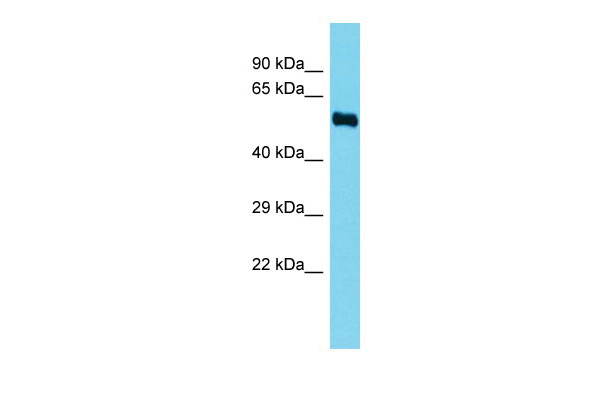
Fads3 Antibody - N-terminal region
Rabbit Polyclonal Antibody
- 产品详情
- 实验流程
Application 
| WB |
|---|---|
| Primary Accession | Q8K1P9 |
| Other Accession | NM_173137, NP_775160 |
| Reactivity | Human, Mouse, Rat, Rabbit, Pig, Dog, Guinea Pig, Horse, Bovine |
| Predicted | Human, Mouse, Rat, Rabbit, Pig, Dog, Guinea Pig, Horse, Bovine |
| Host | Rabbit |
| Clonality | Polyclonal |
| Calculated MW | 51467 Da |
| Gene ID | 286922 |
|---|---|
| Other Names | Fatty acid desaturase 3, 1.14.19.-, Fads3 |
| Format | Liquid. Purified antibody supplied in 1x PBS buffer with 0.09% (w/v) sodium azide and 2% sucrose. |
| Reconstitution & Storage | Add 50 ul of distilled water. Final anti-Fads3 antibody concentration is 1 mg/ml in PBS buffer with 2% sucrose. For longer periods of storage, store at 20°C. Avoid repeat freeze-thaw cycles. |
| Precautions | Fads3 Antibody - N-terminal region is for research use only and not for use in diagnostic or therapeutic procedures. |
| Name | Fads3 {ECO:0000303|PubMed:19752397, ECO:0000303|PubMed:24070791} |
|---|---|
| Function | Mammals have different sphingoid bases that differ in their length and/or pattern of desaturation and hydroxyl groups. The predominant sphingoid base that comprises mammalian ceramides is sphing-4-enine (sphingosine or SPH) which has a trans (E) desaturation at carbon 4. FADS3 is a desaturase that introduces a cis (Z) double bond between carbon 14 and carbon 15 of the sphingoid base (also known as long chain base, LCB), producing LCBs such as sphinga-4,14-dienine (SPD, d18:2(4E,14Z)) from SPH. Prefers SPH-containing ceramides (N- acylsphing-4-enines) as substrates. Capable of metabolizing also the SPH in its free form. SPD ceramides occur widely in mammalian tissues and cells. Due to their unusual structure containing a cis double bond, SPD ceramides may have an opposite, negative role in lipid microdomain formation relative to conventional ceramides. Could be involved in the detoxification of 1-deoxy sphingolipids, by desaturating the cytotoxic 1-deoxysphinganine (1-deoxySA, m18:0), produced under pathological conditions, to 1-deoxysphingenine (1-deoxysphingosine, 1-deoxySO, m18:1). Although prefers SPH-containing ceramides (N-acylsphing-4- enines) as substrates, it also exhibits activity toward dihydrosphingosine-containing CERs (N-acylsphinganines) and produces 14Z-SPH-containing sphingolipids. Its desaturase mechanism involves an electron transfer facilitated by cytochrome b5 (By similarity). FADS3 also acts as a methyl-end fatty acyl coenzyme A (CoA) desaturase that introduces a cis double bond between the preexisting double bond and the terminal methyl group of the fatty acyl chain. Desaturates (11E)- octadecenoate (trans-vaccenoate, the predominant trans fatty acid in human milk) at carbon 13 to generate (11E,13Z)-octadecadienoate (also known as conjugated linoleic acid 11E,13Z-CLA) (PubMed:24070791, PubMed:30262139). |
| Cellular Location | Endoplasmic reticulum membrane {ECO:0000250|UniProtKB:Q9Y5Q0}; Multi-pass membrane protein |
| Tissue Location | Essentially expressed in liver and kidney and to a lesser extent in heart, adipose tissue, stomach and pancreas (at protein level) (PubMed:19752397). Higher expression in lactating mammary gland than in liver (PubMed:30262139) |
Research Areas
For Research Use Only. Not For Use In Diagnostic Procedures.
Application Protocols
Provided below are standard protocols that you may find useful for product applications.
REFERENCES
D'Andrea S.,et al.Submitted (JUL-2002) to the EMBL/GenBank/DDBJ databases.

终于等到您。ABCEPTA(百远生物)抗体产品。
点击下方“我要评价 ”按钮提交您的反馈信息,您的反馈和评价是我们最宝贵的财富之一,
我们将在1-3个工作日内处理您的反馈信息。
如有疑问,联系:0512-88856768 tech-china@abcepta.com.


