


 癌症的基本特征包括细胞增殖、血管生成、迁移、凋亡逃避机制和细胞永生等。找到癌症发生过程中这些通路的关键标记物和对应的抗体用于检测至关重要。
 为您推荐一个泛素化位点预测神器——泛素化分析工具,可以为您的蛋白的泛素化位点作出预测和评分。
 细胞自噬受体图形绘图工具为你的蛋白的细胞受体结合位点作出预测和评分,识别结合到自噬通路中的蛋白是非常重要的,便于让我们理解自噬在正常生理、病理过程中的作用,如发育、细胞分化、神经退化性疾病、压力条件下、感染和癌症。
CD54 / ICAM-1 Antibody - With BSA and Azide
Mouse Monoclonal Antibody [Clone W-CAM-1; same as Wehi-CAM-1 or 1H4 ]
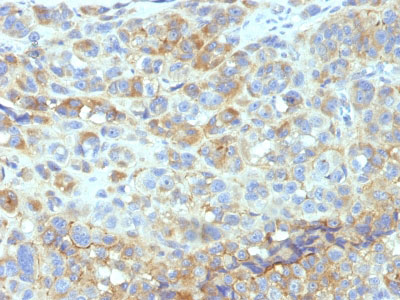
- 产品详情
- 实验流程
- 背景知识
Application 
| IHC, IF, FC |
|---|---|
| Primary Accession | P05362 |
| Other Accession | 3383, 643447 |
| Reactivity | Human |
| Host | Mouse |
| Clonality | Monoclonal |
| Isotype | Mouse / IgG2b, kappa |
| Clone Names | W-CAM-1; same as Wehi-CAM-1 or 1H4 |
| Calculated MW | 57825 Da |
| Gene ID | 3383 |
|---|---|
| Other Names | Intercellular adhesion molecule 1, ICAM-1, Major group rhinovirus receptor, CD54, ICAM1 |
| Application Note | IHC~~1:100~500 IF~~1:50~200 FC~~1:10~50 |
| Storage | Store at 2 to 8°C.Antibody is stable for 24 months. |
| Precautions | CD54 / ICAM-1 Antibody - With BSA and Azide is for research use only and not for use in diagnostic or therapeutic procedures. |
| Name | ICAM1 (HGNC:5344) |
|---|---|
| Function | Cell adhesion molecule that functions as a receptor ligand of the signaling receptor ITGAL:ITGB2/LFA-1 (lymphocyte-function associated (LFA) molecule 1) ensuring leukocyte cell-cell adhesion, by providing a calibrated system to namely adjust T-cell killing to the antigen stimulation strength (PubMed:3086451, PubMed:3340213, PubMed:38195629). Also functions as a ligand receptor of the signaling receptor ITGAM:ITGB2/MAC-1 ensuring adhesion between stimulated neutrophils and stimulated endothelial cells (PubMed:1980124). During leukocyte trans-endothelial migration, ICAM1 engagement promotes the assembly of endothelial apical cups through ARHGEF26/SGEF and RHOG activation (PubMed:17875742). Promotes cell aggregation in epithelial cells through interaction with MUC1 (PubMed:11173916). |
| Cellular Location | Cell membrane; Single-pass type I membrane protein |
| Tissue Location | Expressed on non-hematopoietic cells such as vascular endothelial cells, thymic epithelial cells, certain other epithelial cells, and fibroblasts, and on hematopoietic cells such as tissue macrophages, mitogen-stimulated T lymphocyte blasts, and germinal center dendritic cells in tonsils, lymph nodes, and Peyer's patches (PubMed:3086451). Expressed in low amounts on peripheral blood leukocytes (PubMed:3086451). |
For Research Use Only. Not For Use In Diagnostic Procedures.
Provided below are standard protocols that you may find useful for product applications.
BACKGROUND
Recognizes an 85-115kDa protein (variation with cell type), identified as intercellular adhesion molecule (ICAM-1) (Workshop IV). It has 7 potential N-linked glycosylation sites. ICAM-1 is a single chain glycoprotein of Ig supergene family, present on unstimulated endothelial cells (EC) and on a variety of other cell types including activated fibroblasts, EC, macrophages, and lymphocytes. ICAM-1 mediates cell adhesion by binding to integrins CD11a/CD18 (leukocyte adhesion molecule, LFA-1) and to CD11b/CD18 (Mac-1). This interaction enhances antigen-specific T-cell activation. ICAM-1 also binds to CD43 and to Plasmodium falciparum infected RBCs. W-CAM-1 MAb blocks aggregation of cell lines mediated by the ICAM-1 and blocks homotypic binding of purified populations of activated T- and B-lymphocytes and also aggregation of mixed T- and B-cell blasts. It inhibits T-cell adhesion to normal human endothelial cells. Activation induced by cell-cell contact (mixed lymphocyte reaction, T-cell mediated B-cell activation) is significantly inhibited. This MAb blocks elements of both effector arms of immune system (cytotoxic cell function and Ig production).
REFERENCES
Boyd AW et. al. Blood, 1989, 73(7):1896-903. | Boyd AW et. al. Proceedings of the National Academy of Sciences, 1988, 85(9):3095 | Wawryk et al. J Clin Pathol 44, 497-501 (1991). | Fecondo et al., Proc. Nat. Acad. Sci. 88(7), 28792882, (1991)

终于等到您。ABCEPTA(百远生物)抗体产品。
点击下方“我要评价 ”按钮提交您的反馈信息,您的反馈和评价是我们最宝贵的财富之一,
我们将在1-3个工作日内处理您的反馈信息。
如有疑问,联系:0512-88856768 tech-china@abcepta.com.


