


 癌症的基本特征包括细胞增殖、血管生成、迁移、凋亡逃避机制和细胞永生等。找到癌症发生过程中这些通路的关键标记物和对应的抗体用于检测至关重要。
 为您推荐一个泛素化位点预测神器——泛素化分析工具,可以为您的蛋白的泛素化位点作出预测和评分。
 细胞自噬受体图形绘图工具为你的蛋白的细胞受体结合位点作出预测和评分,识别结合到自噬通路中的蛋白是非常重要的,便于让我们理解自噬在正常生理、病理过程中的作用,如发育、细胞分化、神经退化性疾病、压力条件下、感染和癌症。
NME4 Antibody (N-term)
Purified Rabbit Polyclonal Antibody (Pab)
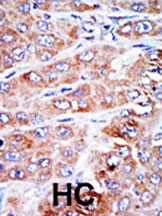
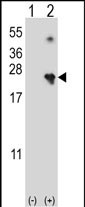
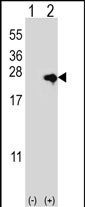
- 产品详情
- 文献引用 : 1
- 实验流程
- 背景知识
Application 
| IHC-P, WB, E |
|---|---|
| Primary Accession | O00746 |
| Reactivity | Human |
| Host | Rabbit |
| Clonality | Polyclonal |
| Isotype | Rabbit IgG |
| Calculated MW | 20659 Da |
| Antigen Region | 1-30 aa |
| Gene ID | 4833 |
|---|---|
| Other Names | Nucleoside diphosphate kinase, mitochondrial, NDK, NDP kinase, mitochondrial, Nucleoside diphosphate kinase D, NDPKD, nm23-H4, NME4, NM23D |
| Target/Specificity | This NME4 antibody is generated from rabbits immunized with a KLH conjugated synthetic peptide between 1-30 amino acids from the N-terminal region of human NME4. |
| Dilution | IHC-P~~1:100~500 WB~~1:1000 E~~Use at an assay dependent concentration. |
| Format | Purified polyclonal antibody supplied in PBS with 0.09% (W/V) sodium azide. This antibody is prepared by Saturated Ammonium Sulfate (SAS) precipitation followed by dialysis against PBS. |
| Storage | Maintain refrigerated at 2-8°C for up to 2 weeks. For long term storage store at -20°C in small aliquots to prevent freeze-thaw cycles. |
| Precautions | NME4 Antibody (N-term) is for research use only and not for use in diagnostic or therapeutic procedures. |
| Name | NME4 (HGNC:7852) |
|---|---|
| Synonyms | NM23D |
| Function | Mitochondria-specific nucleoside diphosphate kinase that catalyzes the transfer of a gamma-phosphoryl group from ATP to a nucleoside diphosphate via a ping-pong mechanism involving a phosphohistidine intermediate, participating in nucleoside triphosphate homeostasis (PubMed:10799505, PubMed:16313181, PubMed:18635542, PubMed:23150663). In vitro, purine nucleoside triphosphates are much more effective as donors and acceptors than pyrimidine nucleoside triphosphates, and ribonucleosides derivatives are superior to their deoxyribonucleosides counterparts (By similarity). Associates with cardiolipin-containing mitochondrial inner membrane and locally produces ADP in the mitochondrial intermembrane space, which is directly taken up via the ADP/ATP translocase (ANT) into the matrix to stimulate respiratory ATP regeneration (PubMed:18635542, PubMed:24970086). Also directly provides GTP for mitochondrial GTPases, such as the dynamin-related GTPase OPA1 (PubMed:24970086). Additionally, catalyzes the anionic phospholipid transfer, namely cardiolipin, from the mitochondrial inner membrane (IM) to the outer membrane (OM) through the formation of contact sites between IM and OM, in a nucleoside diphosphate kinase-independent manner (PubMed:17028143, PubMed:23150663). The switch between the nucleoside diphosphate kinase and the phospholipid transfer activity may depend on the availability and accessibility of cardiolipin and other anionic phospholipids in the IM outer leaflet and OM inner leaflet (PubMed:23150663). |
| Cellular Location | Mitochondrion intermembrane space; Peripheral membrane protein Mitochondrion matrix. Mitochondrion outer membrane Note=Predominantly localized in the mitochondrion intermembrane space (PubMed:18635542). Colocalizes with OPA1 in mitochondria (Probable) (PubMed:24970086). Phospholipid binding mediates mitochondrial inner membrane binding (Probable) (PubMed:18635542). Fully membrane-bound, when attached simultaneously to inner membrane (IM) and outer membrane (OM) through the formation of contact sites between IM and OM (Probable) (PubMed:17028143). The additional binding to OM may depend on the availability or accessibility of cardiolipin and/or other anionic phospholipids in the IM outer leaflet and the OM inner leaflet (Probable). |
| Tissue Location | Widely distributed. Found at very high levels in prostate, heart, liver, small intestine, and skeletal muscle tissues, and in low amounts in the brain and in blood leukocytes |
For Research Use Only. Not For Use In Diagnostic Procedures.

Provided below are standard protocols that you may find useful for product applications.
BACKGROUND
Protein kinases are enzymes that transfer a phosphate group from a phosphate donor, generally the g phosphate of ATP, onto an acceptor amino acid in a substrate protein. By this basic mechanism, protein kinases mediate most of the signal transduction in eukaryotic cells, regulating cellular metabolism, transcription, cell cycle progression, cytoskeletal rearrangement and cell movement, apoptosis, and differentiation. With more than 500 gene products, the protein kinase family is one of the largest families of proteins in eukaryotes. The family has been classified in 8 major groups based on sequence comparison of their tyrosine (PTK) or serine/threonine (STK) kinase catalytic domains. The AGC kinase group consists of 63 kinases including the cyclic nucleotide-regulated protein kinase (PKA & PKG) family, the diacylglycerol-activated/phospholipid-dependent protein kinase C (PKC) family, the related to PKA and PKC (RAC/Akt) protein kinase family, the kinases that phosphorylate G protein-coupled receptors family (ARK), and the kinases that phosphorylate ribosomal protein S6 family (RSK).
REFERENCES
Milon, L., et al., Hum. Genet. 99(4):550-557 (1997).

终于等到您。ABCEPTA(百远生物)抗体产品。
点击下方“我要评价 ”按钮提交您的反馈信息,您的反馈和评价是我们最宝贵的财富之一,
我们将在1-3个工作日内处理您的反馈信息。
如有疑问,联系:0512-88856768 tech-china@abcepta.com.


